
The holiday shopping season does not really end when the gifts are opened.
For many shoppers, the next phase begins right after Christmas, when markdowns expand, returns start flowing, and gift cards finally turn into real spending power. This CouponCabin Holiday Green survey takes a closer look at how consumers think about post-holiday savings, where they expect the strongest deals, and how quickly they plan to spend the money and gift cards they received.
Most Shoppers Believe the Strongest Deals Come After the Holidays
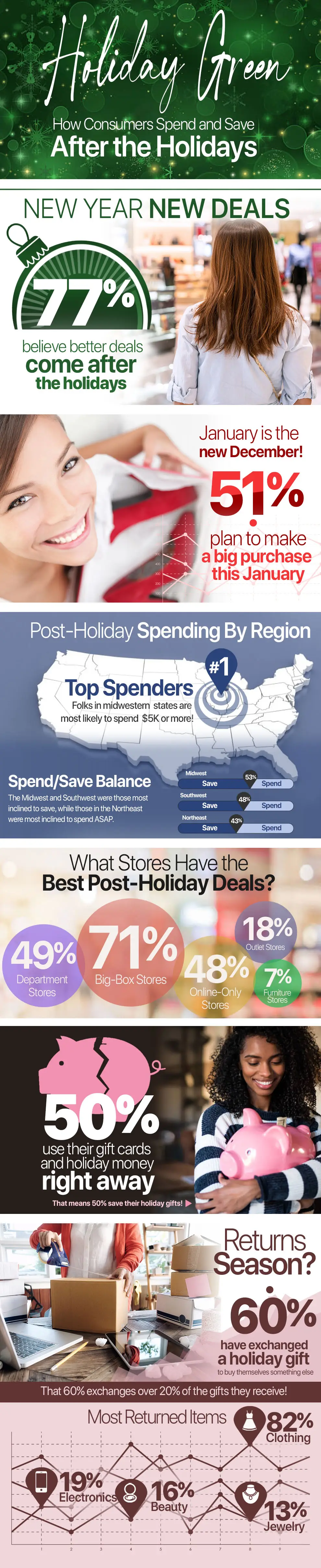
According to the survey, more than 77% of consumers believe bigger deals are available after the holidays. That belief is not just theoretical. Nearly 51% said they planned to take advantage of those deals by making a large purchase in late December or January.
That is the clearest pattern in the survey: many shoppers do not view the holiday season as the finish line. They view it as a setup for a more efficient buying window.
Post-Holiday Spending Can Get Big Fast
When shoppers do make those after-holiday purchases, most land in the mid-range rather than at the extremes. The most common planned spend fell between $100 and $499, showing that post-holiday shopping is often about targeted replacement buying or planned household purchases rather than just small clearance browsing.
At the same time, some consumers planned much bigger purchases. The Midwest stood out as the region most likely to say they would spend $5,000 or more after the holidays, suggesting that major home, furniture, or high-ticket delayed purchases may be playing a role in that market.
Big-Box Stores Still Own the Post-Holiday Deal Mindset
Consumers overwhelmingly pointed to big-box stores like Costco, Target and Walmart as the places where they expected the largest post-holiday deals. That makes it a smart time to compare Costco coupons, Target promo codes and Walmart offers before checking out. Department stores such as Macy's and Kohl's followed behind them, so shoppers should also look for Macy's coupons and Kohl's discount codes when clearance prices start stacking up. E-commerce ranked third, while furniture stores landed lower on the list.
That result matters because it shows shoppers still associate the strongest after-holiday value with broad-inventory retailers that need to clear seasonal inventory quickly. It is not just about one category. It is about scale, urgency, and markdown depth.
Gift Cards and Holiday Cash Usually Get Spent Quickly
If consumers receive cash or gift cards over the holidays, they generally do not sit on them for long. Just over 50% of shoppers said they spend those holiday gifts in the weeks immediately following the holiday season.
Regional behavior did vary:
- Shoppers in the Midwest and Southwest were more likely to save their gift funds for later.
- Shoppers in the Northeast were more likely to spend right away.
That is important because it suggests post-holiday spending is not just about deals. It is also about liquidity. A gift card or cash gift often becomes a trigger for delayed self-purchases.
Gift Exchanges Often Turn Into Self-Directed Spending
Another strong theme in the survey is post-holiday correction. Nearly 60% of shoppers said they have exchanged a holiday gift to buy themselves something else. On average, they exchange more than 20% of the gifts they receive.
Clothing led the list of exchanged items, which is not especially surprising given the usual issues with size, color, and style. But the list also included higher-value categories like electronics, beauty, and jewelry, which shows that post-holiday exchange activity is not limited to small-ticket mistakes.
That points to a larger consumer truth: after the holidays, many shoppers shift from receiving gifts chosen by someone else to making more deliberate decisions for themselves.
What This Survey Really Shows
The takeaway is not just that shoppers like clearance. It is that the post-holiday period serves multiple jobs at once.
It is a markdown season. It is a gift-card spending season. It is a returns and exchange season. And for many consumers, it is the first real chance to buy what they actually wanted at a lower price.
That is why post-holiday shopping can feel more strategic than pre-holiday shopping. Before Christmas, people shop under deadlines. After Christmas, they shop with more information, more flexibility, and often more purchasing power.


 previous
