
Cable is not winning the future. But it is not disappearing cleanly either.
That is the real story inside CouponCabin's 2013 and 2025 survey comparison. Over the last decade, traditional pay TV lost its grip on American households as streaming became the default way many people watch entertainment. Yet the shift has not been perfectly one-directional. Some viewers still keep cable, and a smaller group has returned after discovering that streaming can get expensive, fragmented and harder to manage than it first looked.
How Far Cable Has Fallen
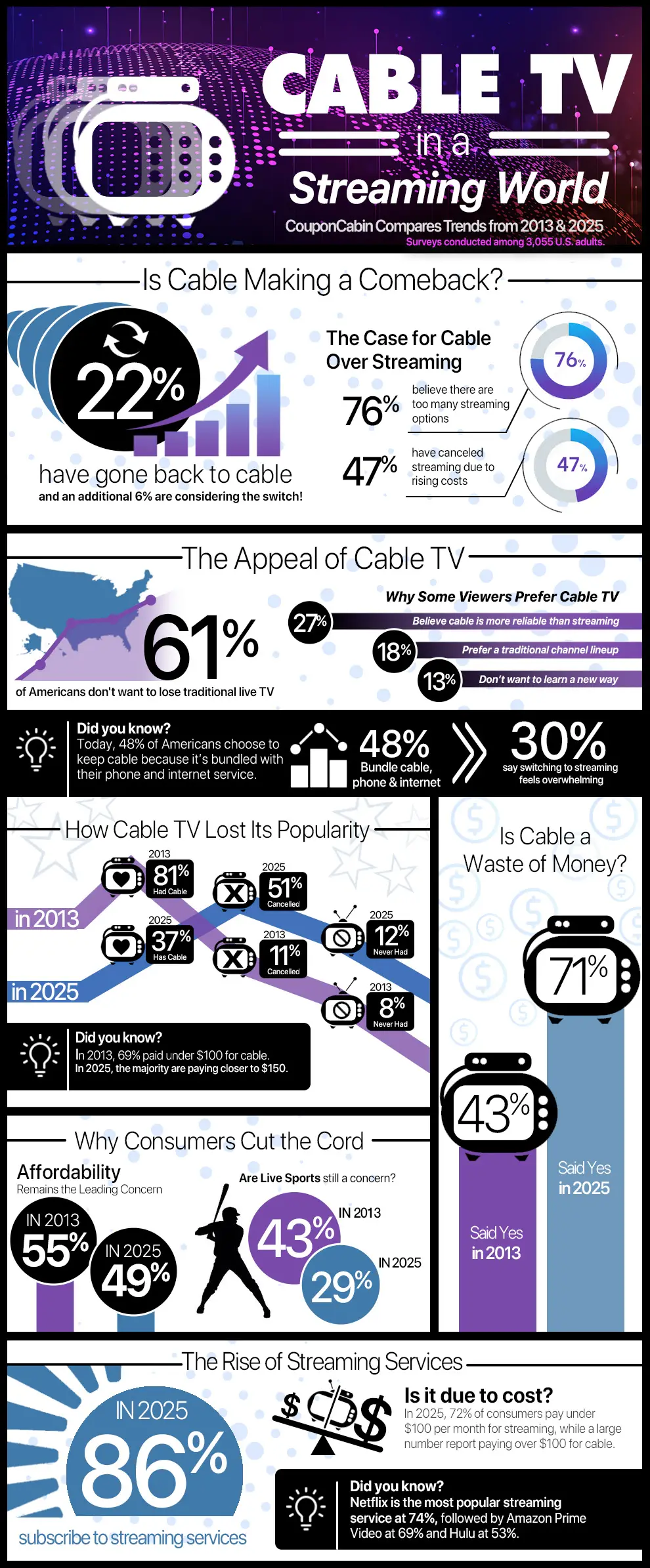
In 2013, 81% of U.S. adults had cable or satellite TV. By 2025, that share had dropped to 37%. Cord-cutting moved from a niche behavior to the dominant story, while the share of adults who never subscribed also grew.
That changes the entire framing of the industry. The question is no longer whether cable is shrinking. It clearly is. The more interesting question is why some households still keep it, and why a smaller group has found its way back.
Is Cable Actually Making a Comeback?
Not in the broad sense. The 2025 data still shows a much smaller cable universe than the one Americans lived with in 2013. But the survey reveals something more nuanced than a clean cord-cutting victory lap.
Among people who had switched from cable to streaming, 22% had returned to cable, while another 6% were considering switching back.
Streaming won on flexibility, lower entry cost and on-demand convenience. But over time, the streaming experience became more crowded, more expensive and more fragmented. Households now juggle multiple apps, rising monthly charges, exclusive sports rights and the constant question of where a show or game actually lives. For some viewers, cable starts to look less like the old expensive bundle and more like a simpler way to reduce decision fatigue.
Why Some Viewers Still Prefer Cable
The appeal of cable in 2025 is less about excitement and more about relief. Viewers who keep it are often paying for stability, habit and a simpler viewing experience.
Some still want live TV in the familiar format. Some trust cable more than streaming when the goal is sitting down and watching without choosing an app first. Others do not want to rebuild their entertainment routine around new interfaces, rotating subscriptions, passwords and separate billing dates.
Bundling still plays a major role, too. CouponCabin's 2025 survey found that 48% of Americans who keep cable do so because it is bundled with phone and internet service. For those households, untangling cable may feel less efficient than it sounds in theory.
Why Consumers Cut the Cord in the First Place
Affordability still sits at the center of the story, just as it did in 2013. Then and now, cost remains the clearest pressure pushing households away from cable.
In 2013, cutting cable still felt more disruptive because traditional TV had a stronger hold on live events, sports and everyday entertainment habits. By 2025, more households were willing to leave because streaming alternatives were far more mature.
Still, the economics are no longer as simple as "cable expensive, streaming affordable." Streaming may look lighter at first glance, but the total can climb quickly once households stack multiple services together.
Why Streaming Won, and Why It Is Frustrating People
Streaming became dominant because it solved obvious problems. It gave viewers more control, more on-demand access and a lower barrier to entry than a full cable package. But the 2025 survey also shows the downside of that freedom.
CouponCabin found that 47% of Americans had canceled one or more streaming subscriptions because of rising costs, and 76% felt there were too many streaming options. That does not mean streaming is losing. It means streaming is maturing into a messier, more expensive system than many households expected when they first cut the cord.
That is the opening cable still has. Not growth at scale, but relevance among viewers tired of subscription sprawl.
Is Cable a Waste of Money?
The answer depends on what the household is buying. The 2025 survey shows much more skepticism around cable's value than in 2013. In 2013, 45% of U.S. adults believed cable was a waste of money. By 2025, that share had climbed to 71%.
That is a major signal. Americans have become far more willing to say the traditional bundle does not justify its price.
But value is no longer only about the lowest monthly number. For some households, convenience, live programming and bundled billing still carry enough weight to keep cable in the mix.
The Real Shift From 2013 to 2025
The biggest change is not just that fewer people have cable. It is that cable stopped being the unquestioned default. In 2013, most people still lived inside that system even if they were unhappy with the cost. By 2025, the default had changed. Viewers had more choices, more control and more reasons to walk away.
But freedom created its own frustrations. The 2025 consumer is not simply escaping cable. That consumer is trying to manage a fragmented entertainment world with fewer illusions about any option being truly simple.


 previous
