How COVID-19 Reshaped Holiday Spending
Financial pressure sat at the center of the 2020 holiday outlook. In CouponCabin's survey, 70% of Americans said the pandemic had negatively affected their finances. The strain was not evenly distributed. Households earning under $50,000 and adults with children under 18 were more likely to report significant or moderate financial harm than higher-income households or adults without children at home.
That financial stress carried directly into holiday expectations. More than half of holiday shoppers believed most families would spend less on presents in 2020, and 45% thought gifts would become more practical because of the pandemic. That is what made the survey revealing. It did not just show anxiety. It showed how that anxiety translated into shopping decisions.
A Holiday Season Built Around Practicality
The gift preferences reflected the moment clearly. Gift cards led the list at 49%, followed by clothes at 36% and technology at 28%. The more unusual categories told the stronger story:
- 22% wanted personal care or beauty products
- 19% wanted household goods
- 15% wanted cleaning supplies
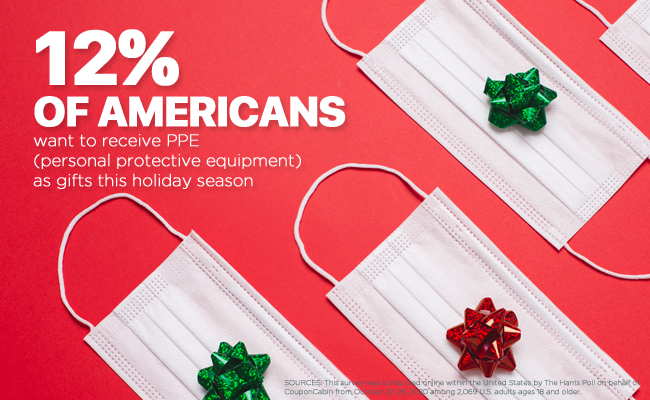
- 12% wanted PPE
Those numbers showed how the pandemic changed the definition of a desirable gift. In a typical holiday year, cleaning supplies and protective equipment would not stand out as notable gift categories. In late 2020, they did. Americans were not just shopping for fun, novelty or indulgence. Many were shopping for utility, comfort and day-to-day function.
Gift Buying Did Not Disappear, But It Became More Selective
Even in a difficult year, gift giving remained a major part of the season. CouponCabin found that 88% of Americans planned to purchase holiday gifts. Most expected to buy for the same number of people as usual, while a smaller group planned to buy for more people and a larger share planned to buy for fewer.
The reasons for cutting back were telling. Among those planning to buy for fewer people, the biggest driver was financial hardship caused by the pandemic. Others pointed to fewer in-person celebrations, changes to gift exchanges or postponed holiday gatherings.
That made 2020 feel less like a canceled holiday season and more like a narrowed one. The ritual remained, but the scale and structure changed.
Debt Anxiety Was Part of the Holiday Mood
Another notable result was that 29% of Americans believed many people would take on debt to preserve the holiday spirit during the pandemic. That matters because it highlights the social pressure built into holiday spending, even during a public-health crisis and a period of economic strain.
The tension was clear. Households wanted to preserve tradition, generosity and connection, but many were trying to do so from a weaker financial position. That made value, practicality and restraint more central to the season than they might have been in prior years.
Why Online Shopping Became Even More Important
The 2020 holiday season also accelerated the shift toward online shopping and lower-contact fulfillment. Pandemic conditions pushed many shoppers away from crowded stores and toward ecommerce, delivery and curbside pickup. That did not just change where purchases happened. It changed how people planned for the season.
Buying early, avoiding shipping delays and minimizing in-store exposure became central parts of holiday strategy. In that environment, convenience and safety were no longer side benefits. They were core decision drivers. The holiday experience became more logistical, more scheduled and more dependent on digital shopping than in a typical year.
How Holiday Gatherings Changed the Gift Equation
Holiday shopping habits were also tied to changing celebration plans. Smaller gatherings, canceled get-togethers, delayed events and virtual celebrations all affected who received gifts and how families approached traditions.
That made gift giving more targeted. If families were not gathering in the usual way, some reduced the number of people they bought for. Others shifted toward practical items, digital gifting or easier-to-send categories. The survey captured a holiday season that was still active, but more deliberate and less expansive.